
Queens Head & Old Bakery Tearoom




The Queen’s Head & Old Bakery Tea Room: Tudor Origins, Ash Yard Tales, and a Bold Mid-Century Transformation
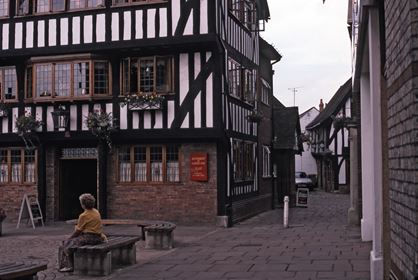
The Queen’s Head began life in the early 1500s, during the Tudor period, when Newark was a thriving market town on the Great North Road. Its timber-framed construction, with jettied upper floors, close-studded panels, and arched braces, truly stand out in town. Originally a private dwelling, it later became an inn, serving merchants and travellers drawn to Newark’s bustling Market Place.
By the 1700s, the Queen’s Head was firmly established as a public house. A cellar door dated 1709 survives as a link to this era. Newark’s position on major coaching routes meant inns were essential for stabling horses and lodging travellers. Records show the pub had stables with a hayloft above, later repurposed as the bakehouse. This was the age when the Queen’s Head Yard bustled with activity, carts, horses, and the chatter of coachmen.
During the Victorian period, the pub’s ground floor was altered with a shopfront-style façade, typical of the era’s commercial aesthetic. This change masked much of its Tudor character, though the upper floors retained their timber frame. The yard continued to serve practical purposes, but Newark’s urban growth began to squeeze out the old coaching traditions.
Next door stood Ashes Bakery, demolished in the late 1950s by Warwicks and Richardsons Brewery, owners of the Queen’s Head. This clearance created Queen’s Head Court, a new passageway leading to Kirkgate, emerging under the arch of McGeorge’s Wine and Spirits Department. (more on that in a bit)
We cant talk about the Queens Head without talking about The Old Bakery Tearoom, situated just behind the pub in queens head court. This so-called “Old Bakery” as we know it, was historically part of the pub, listed in earlier years as stables with a hay store above. it is the last remaining building of the original East Wing of the pub.
For more than 100 years, the building served as a bakery, supplying locals with fresh bread and cakes. This long-standing role earned it the name “Old Bakery.” In later years, it was transformed into a tea room, retaining its historic charm while adapting to modern hospitality. The interior features cozy décor, traditional tables, and heritage details like iron-latched doors and timber ceiling. Adding to its intrigue, the tearoom is reputedly haunted by the ghost of a little girl.
When we walk the path from the right hand side of the Queens head and exit opposite The Violin School, before 1960, this would never have been possible…..
The original Queen’s Head Yard exited onto Middle Gate, almost opposite Stray’s old shop. A narrow footway through the right side of the pub was closed during the brewery’s major renovation in 1959–60. The name Ashes Yard was never official, locals coined it because the yard buildings were once part of the pub estate. (check the map picture to see where the yard originally was)
Then, came THE restoration in 1959–60, when Warwicks and Richardsons Brewery undertook a full renovation:
-
The 19th-century shopfront was removed.
-
The upper floors were rebuilt in new oak, matching original dimensions, with some curved braces reused.
-
The structure appeared more square than before, as the old timbers had warped over centuries.
-
The arched passageway into the yard was incorporated into the bar, as Queen’s Head Court now provided access from Kirkgate.
-
All yard buildings were demolished, ending the existence of Newark’s last complete half-timbered pub yard.
Ive included some drawings, provided by David Marshall which shows the breweries intent for the development, and its wonderful that Warwicks and Richardsons Brewery cared enough to retain the historic character of the Queen’s Head. Rather than sweeping away centuries of history, they chose to rebuild sympathetically, using new oak to match the original dimensions and even reusing some of the curved braces. Their approach ensured that, despite necessary modernisation, the pub’s Tudor spirit survived.
This decision preserved not only the Queen’s Head itself but also the story of Newark’s Market Place, a rare example of a historic building adapted for the future without losing its soul.
These buildings could easily have vanished had the brewery taken a different path.
So next time you trundle past the queens head, really take a moment to LOOK at it and imagine where the original yard would have been and be thankful that we still have these wonderful and important buildings
Pictures attached are from multiple sources, Newark on Trent Memories, Picture the Past, Advertiser archives, inspire archives, Francis Frith Collection, David Marshall, Geoff Norton, Ashley Irons and from the Queens head directly